Events
Olena Strelnyk, Doctor of Sociological Sciences, speaks at the 8th Women's Congress
6 November 2024
On 5 November Olena Strelnyk, Senior Research Fellow of the Department of Social Structures, Doctor of Sociological Sciences, took part in the 8th Women's Congress with a contribution to the panel discussion “Social change: expectations vs reality”. Her contribution concerned the demographic and social challenges to the development of Ukrainian society through the prism of gender issues. Here are its main points.
- The demographic strategy and raising the birth rate: there is no magic pill. The demographic development strategy recently approved by the government is criticised for being unspecific, but there is no country in the world with experience of a significant increase in the birth rate. In the context of demographic challenges, populist initiatives offering simple solutions to complex problems — such as introducing a tax on childlessness or banning abortion — will become more active.
- Demography and sociology recognise that the only constructive instrument for exerting any influence on the birth rate is not the stimulation of births as such but the creation of conditions for families with children. From the standpoint of a feminist researcher I would add that what is also at stake is reducing the effect of having a child on a woman and on her possibilities for public self-realisation and economic activity, since it is precisely women's family duties that are, worldwide, the key factor in gender inequality. The statistics of European countries show that the gender pay gap in fact arises mainly because of mothers. Family policy, which among other things is meant to help balance professional and family life, is therefore also a policy of gender equality.
- The discourse of “demographic catastrophe”, “children are our future”, “we need more women in the labour market”, “we need to bring women with children back from abroad” may become a good justification and entry point for advocating changes in family support policy and care infrastructure, and an occasion to reflect on how far we are from a “society of care”. This is a society in which care is recognised as a social value and in which looking after children and adults is defined as a collective, social responsibility rather than an exclusively private problem of families. It is a society in which the duties of caring for children and adults are distributed between various parts of society: the family, the state, the civic sector and the labour market (for instance through various instruments for supporting workers with family responsibilities).
- The fewer resources the state has for addressing social questions, the greater the burden that falls on women. This concerns care work in particular, both unpaid and paid. For many women the burden has grown because of the war: for mothers of pre-school children, since kindergartens are closed or operate online (and this will have damaging consequences for women's economic activity and for the gender pay gap); for the wives and mothers of wounded servicemen, who provide most of their care because hospitals and rehabilitation programmes cannot cope; and for women in forcibly displaced families, both within the country and abroad.
- Society's resilience during the war is secured not only by the military on the front line, and not only by business or organisations. Society's resilience during the war and practically the whole range of social and humanitarian questions are handled mainly by women working in the social, educational and medical spheres. Their contribution to that resilience is invaluable and invisible. Nurses, family doctors, social workers and kindergarten teachers often work under a heavy load (especially in the context of war) and for the minimum wage; they have few resources for resisting and for defending their rights, and their interests are weakly articulated in the feminist agenda and in public debate generally.
- There is a risk that during the war and after it ends social questions will be seen as untimely; the state has already declared that post-war development will be based on market principles, which will be damaging for many women who depend more on the state and its support. The women's movement cannot change material reality, but any solution to a problem is preceded by naming and voicing it. And that is within our power — to speak on behalf of the women of Ukraine and to voice the kind of society we would like to build.
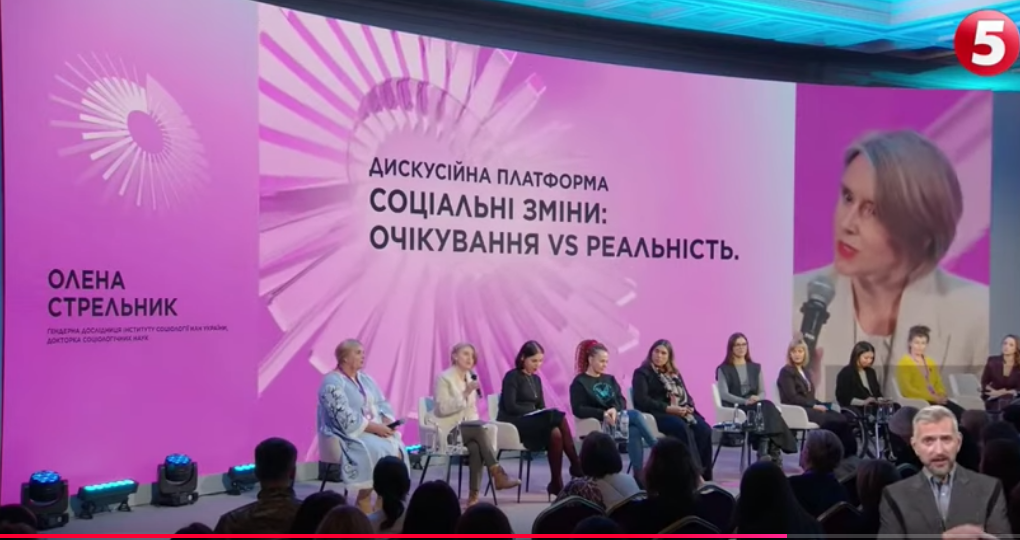
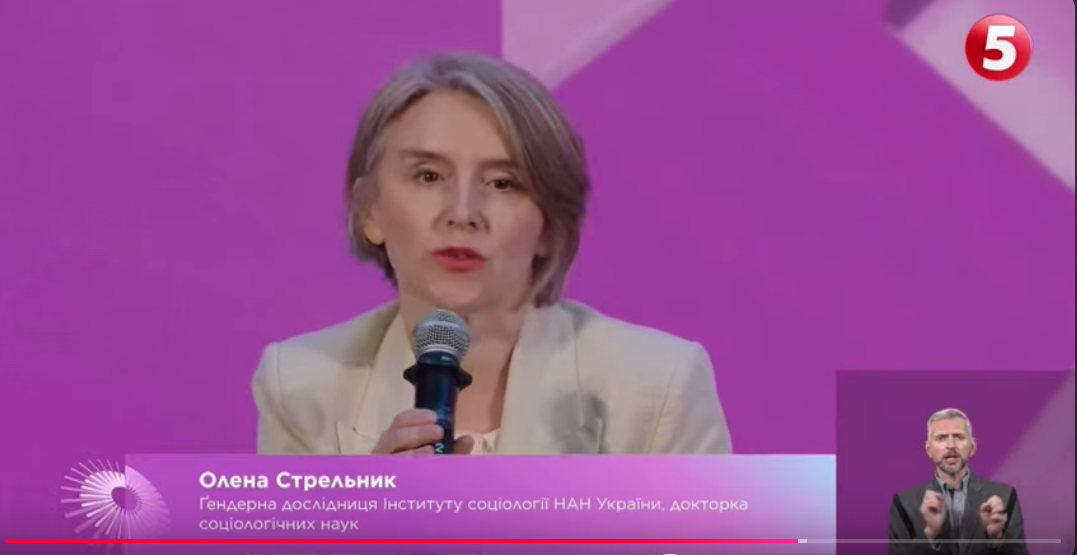
The full recording of the contribution is here:
Institute of Sociology of the NAS of Ukraine
National Academy of Sciences of Ukraine. The country's leading sociology research institution, founded in 1990.
© Institute of Sociology of the NAS of Ukraine. All rights reserved.