Author(s) / Editor(s):
Olena Zlobina, Doctor of Sociological Sciences, Professor, Institute of Sociology of the National Academy of Sciences of Ukraine
email: ezlobina1951@gmail.com
ORCID: https://orcid.org/0000-0003-2593-788X
Reviewers:
Tetyana Tytarenko, Full Member of the National Academy of Educational Sciences of Ukraine, Doctor of Psychological Sciences, Professor, Institute of Social and Political Psychology, National Academy of Educational Sciences of Ukraine
Maryna Sobolevska, Doctor of Sociological Sciences, Associate Professor, Taras Shevchenko National University of Kyiv
Year: 2025
Pages: 354
UDC: 316.4.0:316.6
ISBN: 978-617-14-0406-9
Publication language: Ukrainian
Publisher: Institute of Sociology, National Academy of Sciences of Ukraine
Type of Publication: collective monograph
Publication Place: Kyiv
DOI: https://doi.org/10.15407/book5.978-617-14-0406-9
Full Text: download
Contents:
Chapter 2. Types of Social Expectations (M. Shulga) p. 59
Chapter 6. Social Expectations of Ukrainian War Migrants (The Case of Poland) (S. Shevchenko) p. 195
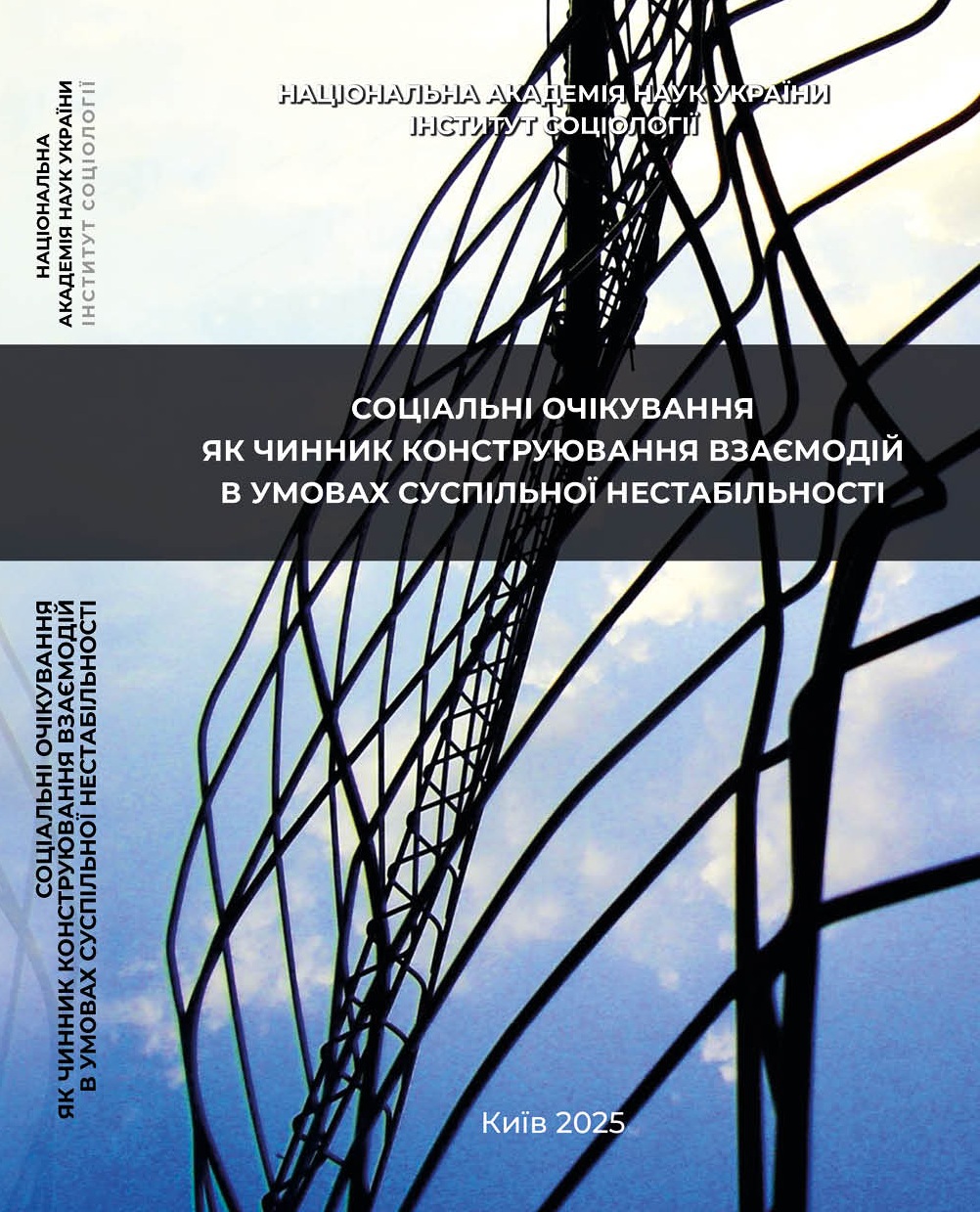
The monograph is a comprehensive study of the role of social expectations in the process of restoring and maintaining social order in the context of a persistent existential threat. It establishes epistemological and conceptual frameworks that enable the examination of sociology of the future in the extreme situation of war. The study conducts a social typology of expectations, identifies the specifics of their development in temporal space, and examines the rational and irrational foundations of the formation of mass expectations. Based on quantitative and qualitative empirical research, the monograph explores social expectations regarding the country’s future, its economic development, and the development of democracy. It also analyzes the transformation of future narratives in the discourse of the Russian-Ukrainian war, particularly visions of future Ukrainian-Russian relations. Special attention is given to Ukrainian war migrants and their expectations regarding their return to their homeland.
References:
Anderson, B. (1983/2001). Imagined Communities: Reflections on the Origin and Spread of Nationalism. Krytyka. (Original work published in 1983).
Arestovych, A. (2019, March 18). A full-scale war with Russia will begin in a couple of years. Apostrof TV. [Video]. YouTube. https://youtu.be/H50ho9Dlrms
Arestovych, A. (2022a, March 5). In Gostomel, special forces of the Main Intelligence Directorate and the 3rd Regiment... Facebook. https://www.facebook.com/alexey.arestovich/posts/5268220136575357
Arestovych, A. (2022b, March 13). The strategic turning point has already arrived. Pryamiy TV Channel. [Video]. YouTube. https://web.archive.org/web/20220314154600/https://www.youtube.com/watch?v=qETYLixjuJY
Arestovych, A. (2022c, August 10). Sensational interview. Guest of Dmytro Gordon. [Video]. YouTube. https://web.archive.org/web/20220821004749/https://www.youtube.com/watch?v=Rfi2GiyeImo
Arestovych, A. (2022d, August 14). Arestovych: Ukraine is an eagle that considers itself a duckling. Politeka Online with Inga Mezereya. [Video]. YouTube. https://web.archive.org/web/20250106185850/https://www.youtube.com/watch?v=vIu5NyHufCw
Arestovych, A. (2022e, May 30). Arestovych: We disrupted the "special operation," now we need to win the war. Feygin Live. [Video]. YouTube. https://web.archive.org/web/20220614024556/https://www.youtube.com/watch?v=NenlLh_T6j4
Barchuk, M. (2024, November 4). The Odesa letter to UNESCO and the postcolonial syndrome. NV.ua. https://nv.ua/ukr/opinion/odesa-yunesko-televeducha-miroslava-barchuk-pro-skandalniy-list-v-italiyskomu-vidanni-50463739.html
Bachega, H. (2023, May 11). Volodymyr Zelenskyy: "We are ready for the counteroffensive." BBC. https://bbc.com/ukrainian/news-65548618
Bevzenko, L. (2018a). Integrative concept of social tension – methodology, conceptual framework, pragmatics. Sociology: Theory, Methods, Marketing, 3, 43–74; 4, 73–104.
Bevzenko, L. (2024). War and the new world order: Variants of expected scenarios in the context of the complexity paradigm. Sociology: Theory, Methods, Marketing, 2, 150–178. https://doi.org/10.15407/sociology2024.02.56
Bilash, K. (2024, October 31). The Odesa letter to UNESCO: "Treason" or "Care for the city." LB.ua. https://lb.ua/culture/2024/10/31/642643_odeskiy_list_yunesko_zrada_chi.html
Budanov, K. (2023, April 17). Will the Armed Forces of Ukraine enter Crimea in the spring? NV.ua. https://nv.ua/ukr/ukraine/events/koli-zakinchitsya-viyna-budanov-dav-prognoz-novini-ukrajini-50318387.html
Butusov, Y. (2022a, March 17). This war will not end quickly! GREAT LVIV SPEAKS. [Video]. YouTube. https://youtu.be/G8fDNfvKUIc
Butusov, Y. (2022b, August 21). Questions and Answers | Butusov LIVE. Butusov Plus. [Video]. YouTube. https://youtu.be/q2jiCLGLuvY
Butusov, Y. (2024a, July 20). Why Ukraine is the only one in the world in the 19th–21st centuries... Facebook. https://www.facebook.com/butusov.yuriy/posts/26368620062751607?ref=embed_post
Butusov, Y. (2024b, March 25). Russia knows how to play on Zelenskyy: Yuriy Butusov on Russian agents in Ukraine’s government. Rendezvous. Channel 5. [Video]. YouTube. https://youtu.be/M1sQScr2gjw
Butusov, Y. (2024c, March 16). One of the best battalion commanders of the Armed Forces of Ukraine... Facebook. https://www.facebook.com/100000909172681/posts/9210273642346183/
Vakhitov, V., Vakhitova, G., & Zaika, N. (2025, March 8). Women in war: Motivations to stay and reasons to leave. Center for Economic Strategy. https://ces.org.ua/wp-content/uploads/2025/03/doslidzhennya-1.pdf
Vedernikova, I. (2024, July 15). War or peace. Ukrainians want to restore the 1991 borders, but by whose hands? Results of a sociological study. ZN.UA. https://zn.ua/ukr/UKRAINE/vijna-chi-mir-ukrajintsi-khochut-povernuti-kordoni-1991-roku-ale-chijimi-rukami-rezultati-sotsiolohichnoho-doslidzhennja.html
Hetmantsev, D. (2025, January 23). Unemployment in Ukraine at a historic low: How many people are actually unemployed. Minfin. https://minfin.com.ua/ua/2025/01/23/143960837/
Hlushchenko, V., Korotyaeva, I., Roman, V., & Rudenko, M. (2024). The Sapir-Whorf hypothesis and the principle of linguistic relativity (linguo-historiographical aspect). Mova, 41, 5–12. https://doi.org/10.18524/2307–4558.2024.41.311204
Gnezdilov, S. (2022, August 4). We need artillery! Sound the broken bells while we cover Pisky with our bodies. Ukrainska Pravda. https://pravda.com.ua/columns/2022/08/4/7361799/
Gnezdilov, S. (2024, September 25). Serhiy Gnezdilov: On desertion, mobilization, government responsibility, and service terms. Babel. [Video]. YouTube. https://youtu.be/MTaUn0DrfHo
Golda, O., & Havrylova, N. (2024). “What are Babel and Paustovsky guilty of?”: Interview with a historian about renaming in Odesa. Suspilne Odesa. [Video]. YouTube. https://suspilne.media/odesa/809133-u-comu-vinni-babel-ta-paustovskij-intervu-z-istorikom-pro-perejmenuvanna-v-odesi/
Holovakha, Y., & Dembitskyi, S. (Eds.). (2024). Ukrainian society in wartime. Year 2024. Institute of Sociology of the National Academy of Sciences of Ukraine.
Hornostay, P. (2012). Collective trauma and group identity. Psychological Perspectives: Special Issue: Current Issues in the Psychology of Small, Medium, and Large Groups, 2, 89–95.
Hrytsak, Y. (2022, April 17). Who will be Carthage – Moscow or Kyiv? Yaroslav Hrytsak on the war for existence. TVOE MISTO. https://tvoemisto.tv/exclusive/ye_dva_ne_vyrishenyh_pytannya_ukrainske_i_rosiyske_yaroslav_grytsak_pro_rosiysku_tragediyu_130954.html
Hromova, H. M., & Tytarenko, T. M. (2023). Valency of the future in the narratives of Ukrainians at the beginning of the war. In V. H. Panok (Ed.), Ukrainian Psychology. 21st Century. The Beginning (Days of Ukrainian Psychology in Berlin): Proceedings of the International Scientific-Practical Conference, April 27–28, 2023 (pp. 318–322). H. S. Kostyuk Institute of Psychology, National Academy of Educational Sciences of Ukraine.
Detector Media. (2021, March). Media literacy index of Ukrainians. Analytical report based on the results of a comprehensive study. https://www.sapiens.com.ua/publications/socpol-research/175/UA_REPORT_MEDIALITERA%D0%A1Y_INDEX-DM.pdf
Dibrova, V. (2023). Personal future of internally displaced persons: Strategies of construction. Problems of Political Psychology, 13(27), 65–76. https://doi.org/10.33120/popp-Vol13-Year2023-130
Drobovych, A. (2024, June 14). The social contract of eternal war. Ukrainska Pravda. https://pravda.com.ua/columns/2024/06/14/7460763/
Durkheim, É. (1897/1998). Suicide: A Sociological Study. Osnovy. (Original work published in 1897).
Espreso. (2024, July 9). “Political games,” “planned action,” and “someone benefits”: How some well-known Ukrainian bloggers reacted to the shelling of Okhmatdyt. https://espreso.tv/kultura-politichni-igrishcha-splanovana-aktsiya-ta-komus-vigidno-yak-ukrainski-blogeri-vidreaguvali-na-obstril-okhmatditu
European Business Association (EBA). (2024, November 21). Labor shortage, high salary expectations, and mobilization – key labor market trends in 2024. https://eba.com.ua/defitsyt-kadriv-vysoki-zarplatni-ochikuvannya-ta-mobilizatsiya-klyuchovi-tendentsiyi-rynku-pratsi-u-2024-rotsi/
Zhabska, Y. (2024, September 20). The government has restricted the use of Telegram. Glavcom. https://glavcom.ua/techno/telecom/vlada-obmezhila-vikoristannja-telegram-1021585.html
Law of Ukraine “On the Condemnation and Prohibition of Propaganda of Russian Imperial Policy in Ukraine and the Decolonization of Toponymy” No. 3005-20 (2023). https://zakon.rada.gov.ua/laws/show/3005-20#Text
Zelenskyy, V. (2022). Volodymyr Zelenskyy and Olena Zelenska gave an interview to the hosts of the telethon. Office of the President of Ukraine. [Video]. YouTube. https://youtu.be/JmQ3f0Y-P1A
Zlobina, O. (2024). Identity versus sense of belonging: New approaches in the study of social self-positioning. Ukrainian Socium, 3-4, 35–51. https://doi.org/10.15407/socium2024.03-04.035
Zlobina, O., & Dembitskyi, S. (2024). The impact of positive and negative expectations on the psychological state of the population: Dispositional optimism vs. prolonged stress. Sociological Studies, 24(1), 24–33. https://doi.org/10.29038/2306-3971-2024-01-21-21
Dobronravova, I. (2017). Practical Philosophy of Science. University Book.
Zhyriy, K. (2024, November 11). Plenty of vacancies and higher salaries: What is the situation on the Ukrainian labor market. UNIAN. https://www.unian.ua/economics/other/robota-v-ukrajini-nazvani-nayzatrebovanishi-specialisti-12816495.html
Ivashyna, O. F. (2014). The problem of rationality in the “mainstream” of economic theory. Effective Economy, 7. http://www.economy.nayka.com.ua/?op=1&z=3171
Kartashov, A. (2024, August 8). Forced decommunization in Odesa? Five myths that need to be debunked. Dzerkalo Tyzhnia. https://zn.ua/ukr/UKRAINE/v-odesi-nasilnitska-dekomunizatsija-pjat-mifiv-jaki-potribno-rozvinchati-shchob-povernuti-mistu-ukrajinsku-dushu.html
Kebuladze, V. (2004). “Structures of the Lifeworld” at the intersection of transcendental phenomenology and phenomenological sociology. In A. Schutz & T. Luckmann, Structures of the Lifeworld (pp. 540–548). Ukrainian Center for Spiritual Culture.
Kelm, N., & Mikhalkov, S. (2025, February 2). Top most popular “experts” on YouTube: Svitan rises to leading positions, “good Russians” remain prevalent. Texty.org.ua. https://texty.org.ua/articles/114535/top-najpopulyarnishyh-ekspertiv-na-yutubi-svitan-vyryvayetsya-na-liderski-pozyciyi-horoshyh-rosiyan-menshe-ne-staye/?fbclid=IwY2xjawJgfBVleHRuA2FlbQIxMQABHq-7JyaaRSWeCQpyVAhF1VSeqknk3lIHI4GA5K7Xpj1DuNO2l8YVdfxr8LHr_aem_l7GKPxEPiiocs5AZa2qWYA
KMIS (2022a, February 17). Attitudes of the Ukrainian population toward Russia and what relations between Ukraine and Russia should be like, February 2022. [Press release]. https://www.kiis.com.ua/?lang=ukr&cat=reports&id=1102&page=1&y=2022&m=2
KMIS (2022b, May 26). Dynamics of population attitudes toward Russia and emotional background due to the war: Results of a telephone survey conducted May 13–18, 2022. [Press release]. https://www.kiis.com.ua/?lang=ukr&cat=reports&id=1112&page=1
KMIS (2023, January 2). Dynamics of willingness to make territorial concessions for the quickest end to the war: Results of a telephone survey conducted December 4–27, 2022. [Press release]. https://kiis.com.ua/?lang=ukr&cat=reports&id=1167&page=1
KMIS (2024a, July 23). Dynamics of willingness to make territorial concessions and attitudes toward specific peace agreement packages. [Press release]. https://kiis.com.ua/?lang=ukr&cat=reports&id=1421&page=1
KMIS (2024b, December 30). How Ukrainians see the future of Ukraine and whether Ukrainians are moving toward unity. [Press release]. https://www.kiis.com.ua/?lang=ukr&cat=reports&id=1463
KMIS (2025, July 9). Are Ukrainians moving toward unity and how Ukrainians see the future of Ukraine. [Press release]. https://www.kiis.com.ua/?lang=ukr&cat=reports&id=1540&page=1
Koselleck, R. (1979/2005). Futures Past: On the Semantics of Historical Time. Dukhi i Litera. (Original work published in 1979).
Kondratyeva, D. (2024, May 20). Yuriy Sodol: Why the public and opinion leaders oppose the new front commander. MEZHA. https://mezha.net/ua/mysli/iurii-sodol-chomu-hromadskist-ta-lidery-suspilnykh-dumok-vystupaiut-proty-novoho-kerivnyka-frontom
Korba, H. (2022, December 30). Telethon: How it is changing Ukrainian society and the media market. BBC News Ukraine. https://www.bbc.com/ukrainian/features-64112594
Kostyuchenko, R. O. (2024, September 8). Ukrainians will be fired more often than hired: Who may lose their jobs. Obozrevatel. https://www.obozrevatel.com/ukr/ekonomika-glavnaya/economy/ukraintsiv-chastishe-zvilnyatimut-nizh-najmatimut-hto-mozhe-zalishitisya-bez-roboti.htm
Kuzenkova, Y. (2024, February 6). The labor market is reviving: Salaries, number of job seekers, and competition increased in January. Work.ua. Analytics. https://www.work.ua/articles/analytics/3234/
Kuznetsova, K. (2023, April 5). I believe it will be very soon: Reznikov named likely timelines for the end of the war. TSN. https://tsn.ua/ato/viryu-scho-duzhe-skoro-reznikov-nazvav-ymovirni-termini-zakinchennya-viyni-2301034.html
Kunetskyi, O. (2024, October 9). Telethon will continue until the end of the war – Minister of Culture. Deutsche Welle. https://www.dw.com/uk/telemarafon-trivatime-do-kinca-vijni-ministr-kulturi/a-70447812
Labyak, I. (2024, October 3). Historian explains why Zelenskyy’s “victory plan” is unrealistic. TSN. https://tsn.ua/politika/istorik-rozpoviv-chomu-plan-peremogi-zelenskogo-nerealniy-2672652.html
Libanova, E. (2012). Problems of labor market development in the context of Ukraine’s social policy, threats, and challenges of the 21st century. Labor Market and Employment, 2, 41–46.
Lutsenko, Y. (2022, May 24). Russia has resources for waging a “normal war” for 12 months – Head of Ukrainian intelligence. Hromadske. https://hromadske.ua/posts/u-rosiyi-resursiv-dlya-vedennya-normalnoyi-vijni-vistachit-na-12-Misyaciv-nachalnik-ukrayinskoyi-rozvidki
Ministry of Economy of Ukraine. (2024). Results of the employer survey on the situation in the Ukrainian labor market. https://me.gov.ua/view/02b2aad8-dc9c-4f88-8f93-499f4f833a64
Mohylevets, A. (2024, November 6). Some Ukrainian universities ban employees from using Telegram. Babel. https://babel.ua/news/112386-ukrajinski-vishi-masovo-zaboronyayut-spivrobitnikam-koristuvatisya-telegram
Musayeva, S., Kutepov, B., Klimov, A., Ihnatenko, A., & Rudenko, Y. (2024, August 23). The edge of the Black Sea. How Odesa lives. Ukrainska Pravda. https://www.pravda.com.ua/articles/2024/08/23/7471453/
National Media Circulation. (2024, September 19). National Media Talk (NMT) 2024, Day 1. [Video]. YouTube. https://youtube.com/live/BJ-bnxJIxJs
National Television and Radio Broadcasting Council of Ukraine. (2025, July 1). Challenges and the future of print media in wartime conditions. https://webportal.nrada.gov.ua/vyklyky-ta-majbutnye-drukovanyh-media-v-umovah-vijny/
National Bank of Ukraine. (2025a). Inflation Report. January 2025. https://bank.gov.ua/admin_Uploads/article/IR_2025-Q1.pdf?v=12
National Bank of Ukraine. (2025b). Business Expectations of Ukrainian Enterprises. Issue No. 1 (77). https://bank.gov.ua/admin_Uploads/article/BOS_2025-Q1.pdf?v=13
National Bank of Ukraine. (2025c). Statistics. Macroeconomic Indicators. Data. https://bank.gov.ua/ua/statistic/macro-indicators
Ovsyaniko-Kulikovskiy, D. N. (1909). Horizons of the future and boundaries of the past. In Collected Works. Vol. 6. Psychology of Thought and Feeling. Artistic Creativity. Foundations of Vedaism (pp. 153–170). Public Benefit; Prometheus.
OPORA. (2022a, June 1). Media consumption of Ukrainians in conditions of full-scale war. OPORA Survey. https://www.oporaua.org/polit_ad/mediaspozhivannia-ukrayintsiv-v-umovakh-povnomasshtabnoyi-viini-opituvannia-opori-24068
OPORA. (2022b, July). Democracy, citizens’ rights and freedoms, and media consumption in wartime conditions. https://www.oporaua.org/viyna/doslidzhennya-demokratiya-prava-i-svobodi-gromadyan-ta-mediaspozhivannya-v-umovah-viyni-24261
Paraschevyn, M. (2024). Tables with survey results. In Y. Holovakha & S. Dembitskyi (Eds.), Ukrainian Society in Wartime. Year 2024 (pp. 413–449). Institute of Sociology of the National Academy of Sciences of Ukraine.
Pylypenko, V., & Smakota, V. (2024). Sociological forecasting: Features of study and contemporary issues. Sociology: Theory, Methods, Marketing, 2, 163–177.
Pilyavska, A. (2024, October 28). Odesa is not Ukraine’s problem, but its solution. Yuriy Romanenko. [Video]. YouTube. https://www.youtube.com/watch?v=6VTDNwVSrz4
Polyova, V. (1996). Letters from B. Lyatoshynsky to V. Polyovy. Muzyka, 1, 22–24.
Razumkov Centre. (2025, March 25). Assessment of the situation in the country... https://razumkov.org.ua/.../vira-v-peremogu-liutyiberezen-2025r
Resheha, V. (2022, August 28). In Pisky... NOVYNARNIA. https://novynarnia.com/2022/08/28/santa-pisky/
Reshetnyak, V. (2024, October 23). Labor market trends in Ukraine... Forbes. https://forbes.ua/company/...24258
Samoylyuk, M. (2025, June 16). Ukraine’s economy tracker during the war. Center for Economic Strategy. https://ces.org.ua/tracker-economy-during-the-war/
Saint Augustine. (1999). Confessions. Osnovy.
Sociological Group “Rating”. (2022a, February 27). Nationwide Survey: Ukraine in Wartime (February 26–27, 2022). https://ratinggroup.ua/research/ukraine/obschenacionalnyy_opros_ukraina_v_usloviyah_voyny_26-27_fevralya_2022_goda.html
Sociological Group “Rating”. (2022b, March 20). Fifth Nationwide Survey: Ukraine in Wartime. https://ratinggroup.ua/research/ukraine/pyatyy_obschenacionalnyy_opros_ukraina_v_usloviyah_voyny_18_marta_2022.html
Sociological Group “Rating”. (2022c, August 23). Seventeenth Nationwide Survey: Identity. Patriotism. Values (August 17–18, 2022). https://ratinggroup.ua/research/ukraine/s_mnadcyate_zagalnonac_onalne_opituvannya_dentichn_st_patr_otizm_c_nnost_17-18_serpnya_2022.html
Strashkulyk, A., & Romanuk, R. (2024, April 8). Free media empire. Why the authorities do not want to abandon the telethon. Ukrainska Pravda. https://www.pravda.com.ua/articles/2024/04/8/7450157/
Trapeznikova, D. Life in a smartphone. How Ukrainians used media and social networks in 2024. USAID / Internews study (updated). Mediamaker. https://mediamaker.me/usaid-internews-2024-mediaspozhyvannya-ukraincziv-12518/?utm_source=telegram&utm_medium=post&utm_campaign=usaid-internews-2024
Ukrinform. (2023, December 21). The “United News” telethon is needed until the end of the war. https://www.ukrinform.ua/rubric-society/3803364-telemarafon-edini-novini-potriben-do-kinca-vijni-poturaev.html
Khersonsky, B. (2024, October 25). Excerpt from correspondence... Facebook. https://www.facebook.com/borkhers/posts/pfbid02oPS9tJYbcCbWE3YMdftmUNZVQi5D6JtkYRa8iK7rkmfKETfMcBwQWx3B4eCqyj46l
Khomenko, S., & Aksyonov, P. (2023, May 12). Awaiting the inevitable: Where, how, when, and why the Ukrainian offensive will take place. BBC. https://www.bbc.com/ukrainian/features-65568480
Razumkov Centre. (2023, March 31). Public opinion on the war, victory, and security guarantees (February–March 2023). https://razumkov.org.ua/napriamky/sotsiologichni-doslidzhennia/gromadska-dumka-pro-viinu-peremogu-ta-garantii-bezpeky-liutyi-berezen-2023r
Shevchenko, S. (2024). Social expectations and uncertainty – an attempt to outline the relationship. In V. Y. Saveliev et al. Problems of Sociological Theory Development. https://sociology.knu.ua/sites/default/files/newsfiles/2023-issuesinthedevelopmentofsociologicaltheory_proceedings.pdf
Shtekel, L. (2024, October 21). When I read... Facebook. https://www.facebook.com/leonid.shtekel/posts/pfbid0RbshjtoReL4uQqZUS5CCieL6GfbqD6cQ8cEPhBFRMqV5kLT6x4HfJqn12esRownTl
Schutz, A., & Luckmann, T. (1973/2004). Structures of the Lifeworld. Ukrainian Center for Spiritual Culture.
Yatsenko, L. (2024a). Main characteristics of the Ukrainian labor market in the first half of 2024. National Institute for Strategic Studies. https://niss.gov.ua/sites/default/files/2024-08/az_rinok-praci_i_24_16082024.pdf
Yatsenko, L. (2024b). Restoration of the Ukrainian labor market in wartime conditions: Regional aspects. National Institute for Strategic Studies. https://niss.gov.ua/sites/default/files/2024-03/az_regrinki-praci_04032024.pdf
Aharoni, T., Tenenboim-Weinblatt, K., Kligler-Vilenchik, N., Boczkowski, P., Hayashi, K., Mitchelstein, E., & Villi, M. (2024). Trust-oriented affordances: A five-country study of news trustworthiness and its socio-technical articulations. New Media & Society, 26(6), 3088-3106. https://doi.org/10.1177/14614448221096334
Ahvenharjua, S., Minkkinena, M., & Lalotb, F. (2018). The five dimensions of futures consciousness. Futures, 104, 1-13. https://doi.org/10.1016/j.futures.2018.06.010
AIN.UA. (2023, 14 November). Де українці читають новини: топ месенджерів, соцмереж та блогерів. https://ain.ua/2023/11/14/top-dzherela-novyn-2023/
Alexander, J. C. (2005). Cultural Trauma and Collective Identity. In J. C. Alexander, The meanings of social life: A cultural sociology (pp. 85-108). Oxford University Press. https://doi.org/10.1093/acprof:oso/9780195160840.003.0013
Allana, S., & Clark, A. (2018). Applying meta-theory to qualitative and mixed-methods research: A discussion of critical realism and heart failure disease management interventions research. International Journal of Qualitative Methods, 17(1), 1-9. https://doi.org/10.1177/1609406918790042
Andersson, J. (2018). The future of the world: Futurology, futurists, and the struggle for the postcold war imagination. Oxford University Press.
Allen, B., O'Loughlin, P., Jasperson, A., & Sullivan, J. L. (1994). The media and the gulf war: Framing, priming, and the spiral of silence. Polity, 27(2), 255-284. https://doi.org/10.2307/3235175
Altay, S., Nielsen, R. K., & Fletcher, R. (2022). Quantifying the «infodemic»: People turned to trustworthy news outlets during the 2020 coronavirus pandemic. Journal of Quantitative Description: Digital Media, 2, 1-29. https://doi.org/10.51685/jqd.2022.020
Appadurai, A., Marco, A., & Sassatelli, R. (2013). The future as cultural fact: Essays on the global condition. Rassegna Italiana di Sociologia, 54(4), 651-673. https://doi.org/10.1423/76023
Arestovych [@arestovych] (2024, 8 липня). Страшная трагедия удара по детям дала повод «партии войны» снова раскричаться. Пост. Х. https://x.com/arestovych/status/1810301143420952582?s=46
Archer, M. (1995). Realist social theory: The morphogenetic approach. Cambridge University Press. https://doi.org/10.1017/CBO9780511557675
Archer, M., Bhaskar, R., Collier, A., Lawson, T., & Norrie, A. (2013). Critical realism: Essential readings. Routledge. https://doi.org/10.4324/9781315008592
Anguera, C., & Santisteban, A. (2016). Images of the future: Perspectives of students from Barcelona. Journal of Futures Studies, 21(1), 1-18. https://doi.org/10.6531/JFS.2016.21(1).A1
Augustine, G., Soderstrom, S., Milner, D., & Weber, K. (2019). Constructing a distant future: Imaginaries in geoengineering. Academy of Management Journal, 62(6), 1930-1960. https://doi.org/10.5465/amj.2018.0059
Bandura, A. (1977). Social Learning Theory. Prentice Hall.
Barber, B. (1983). The Logic and Limits of Trust. Rutgers University Press.
Barberá, P. (2015). How Social Media Reduces Mass Political Polarization: Evidence from Germany, Spain, and the U.S. Working Paper. http://pablobarbera.com/static/barbera_polarization_APSA.pdf
Basilici, M. C., Remondi, C., Nocentini, A., & Gerbino, M. (2025). Collective stressful events and individual future orientation: a systematic review. Current Psychology, 44, 10886-10898. https://doi.org/10.1007/s12144-025-07921-w
Baszczak, Ł., Kiełczewska, A., Kukołowicz, P., Wincewicz, A., & Zyzik, R. (2022). Pomoc polskiego społeczeństwa dla uchodźców z Ukrainy. Polski Instytut Ekonomiczny.
Bauman, Z. (1991). A Sociological Theory of Postmodernity. Thesis Eleven, 29(1), 33-46. https://doi.org/10.1177/072551369102900104
Bauman, Z. (1992). Mortality, immortality, and other life strategies. Polity Press.
Baumeister, R. F., Hofmann, W., Summerville, A., Reiss, P. T., & Vohs, K. D. (2020). Everyday Thoughts about the past, present, and future: Experience sampling studies of mental time travel. Personality and Social Psychology Bulletin, 46(12), 1631-1648. https://doi.org/10.1177/0146167220908411
Bazzani, G. (2022). Futures in action: Expectations, imaginaries and narratives of the future. Sociology, 57(2), 382-397. https://doi.org/10.1177/00380385221138010
Beck, U. (1992). Risk Society: Towards a New Modernity. SAGE Publications Ltd.
Beckert, J. (2013a). Capitalism as a System of Expectations: Toward a Sociological Microfoundation of Political Economy. Politics & Society, 41(3), 323-350. https://doi.org/10.1177/0032329213493750
Beckert, J. (2013b). Imagined futures: Fictional expectations in the economy. Theory and Society, 42(3), 219-240. https://doi.org/10.1007/s11186-013-9191-2
Beckert, J. (2016). Imagined futures: Fictional expectations and capitalist dynamics. Harvard University Press. https://doi.org/10.4159/9780674545878
Beckert, J., & Bronk, R. (2018). An Introduction to Uncertain Futures. In J. Beckert & R. Bronk (Eds.), Uncertain Futures (pp. 1-36). Oxford University Press. https://doi.org/10.1093/oso/9780198820802.003.0001
Beckert, J., & Suckert, L. (2020). The future as a social fact. Poetics, 101499. https://doi.org/10.1016/j.poetic.2020.101499
Ben-Zur, H., & Almog, N. (2013). Post-traumatic symptoms and future orientation among Israeli adolescents two years after the Second Lebanese War. Journal of Child & Adolescent Trauma, 6, 187-200. https://doi.org/10.1080/19361521.2013.807324
Berger, P. L., & Luckmann, T. (1966/1991). The social construction of reality. A treatise on sociology of knowledge. Penguin Books.
Bergnehr, D. (2018). Children's influence on wellbeing and acculturative stress in refugee families. International Journal of Qualitative Studies on Health and Well-being, 13(1), 1564517. https://doi.org/10.1080/17482631.2018.1564517
Berry, J. W. (2007). Acculturation strategies and adaptation. In J. E. Lansford, K. Deater-Deckard, & M. H. Bornstein (Eds.), Immigrant families in contemporary society (pp. 69-82). The Guilford Press.
Bertilsson, M. (2003). The social as trans-genic on bio-power and its implications for the social. ACTA SOCIOLOGICA, 46(2), 118-131. https://doi.org/10.1177/0001699303046002003
Bhaskar, R. (1975). Forms of realism. Philosophica, 15(1), 99-127. http://www.philosophica.ugent.be/fulltexts/15-8.pdf https://doi.org/10.21825/philosophica.82713
Bidart, C. (2019). How plans change: Anticipation, interferences and unpredictabilities. Advances in life course research, 41, 100254. https://doi.org/10.1016/j.alcr.2018.10.007
Blöbaum, B. (2016). Trust and communication in a digitized world. Models and concepts of trust research. Springer. https://doi.org/10.1007/978-3-319-28059-2
Boot, A. B., Dijkstra, K., & Zwaan, R. A. (2021). The processing and evaluation of news content on social media is influenced by peer-user commentary. Humanities and Social Sciences Communications, 8(1), 1-11. https://doi.org/10.1057/s41599-021-00889-5
Borup, M., Brown, N., Konrad, K., & Van Lente, H. (2006). The sociology of expectations in science and technology. Technology Analysis & Strategic Management, 18(3), 285-298. https://doi.org/10.1080/09537320600777002
Bourdieu, P., & Wacquant, L. P. D. (1992). An Invitation to Reflexive Sociology. University of Chicago Press.
Bootz, J. P. (2010). Strategic foresight and organizational learning: A survey and critical analysis. Technological Forecasting and Social Change, 77(9), 1588-1594. https://doi.org/10.1016/j.techfore.2010.06.015
Bourdieu, P. (1973). The three forms of theoretical knowledge. Social Sciences Information, 12(1), 53-80. https://doi.org/10.1177/053901847301200103
Bourdieu, P. (1980/1990). The Logic of Practice. Polity Press. (Оригінальна праця опублікована у 1980 році). https://doi.org/10.1515/9781503621749
Braudel, F. (1994). A History of Civilizations. Viking Adult.
Brown, N., & Michael, M. (2003). A Sociology of expectations: Retrospecting prospects and prospecting retrospects. Technology Analysis and Strategic Management, 15(1), 3-18. https://doi.org/10.1080/0953732032000046024
Budni.robota.ua (2024, травень, 10). Що треба знати про український ринок праці у 2024 році? Дослідження та аналітика від robota.ua. https://budni.robota.ua/career/shho-treba-znati-pro-ukrayinskiy-rinok-pratsi-u-2024-rotsi-doslidzhennya-ta-analitika-vid-robota-ua
Bulle, N., & Di Irio, F. (2023). Methodological individualism and critical realism: Question for Margaret Archer. In N. Bulle & F. Di Irio (Eds.), The Palgrave Handbook of Methodological Individualism (pp. 659-668). Springer International Publishing. https://doi.org/10.1007/978-3-031-41508-1_28
Burliai, A., Demianchuk, M., & Burliai, O. (2023). Unintended transnationalism of Ukrainian military migrants in Poland: Socio-cultural aspect. Problems and Perspectives in Management, 21(2), 426-438. https://doi.org/10.21511/ppm.21(2).2023.40
Byrne, D. (1998). Complexity theory and the social sciences: An Introduction. Routledge. https://doi.org/10.4324/9780203003916
Callon, M. (1986). Elements of a sociology of translation: Domestication of the scallops and the fishermen of St Brieuc bay. In J. Law (Ed.), Power, action and belief: A new sociology of knowledge (pp. 196-223). Routledge. https://doi.org/10.1111/j.1467-954X.1984.tb00113.x
Cambridge Dictionary. (n.d.). Trust. In Cambridge Dictionary. Retrieved June 4, 2025, from https://dictionary.cambridge.org/dictionary/english/trust
Carstensen, L. L., Isaacowitz, D. M., & Charles, S. T. (1999). Taking time seriously: A theory of socioemotional selectivity. American Psychologist, 54(3), 165-181. https://doi.org/10.1037/0003-066X.54.3.165
Carter, R. F., & Greenberg, B. S. (1965). Newspapers or television: Which do you believe? Journalism Quarterly, 42(1), 29-34. https://doi.org/10.1177/107769906504200104
Castellani, B., & Gerrits, L. (2024). The atlas of social complexity. Edward Elgar Publishing. https://doi.org/10.4337/9781789909524.00021
Ceccoli, V. C. (2004). Finding home in (an)other: Relational chemistry and its psychoanalytic derivations. Psychoanalytic Dialogues, 14(3), 337-348. https://doi.org/10.1080/10481881409348790
Chen, L. (2023). Habitus beyond Bourdieu: In and out of translation studies. Perspectives, 1-9. https://doi.org/10.1080/0907676X.2023.2213538
Clemm von Hohenberg, B., & Guess, A. M. (2023). When do sources persuade? The effect of source credibility on opinion change. Journal of Experimental Political Science, 10(3), 328-342. https://doi.org/10.1017/XPS.2022.2
Cleveland, J. (1994). Complexity Theory: Basic Concepts and Application to Systems Thinking. Innovation Network For Communities. http://www.slideshare.net/johncleveland/complexity-theory-basic-concepts
Collet, F. (2009). Does habitus matter? A comparative review of Bourdieu's habitus and Simon's bounded rationality with some implications for economic sociology. Sociological Theory, 27(4), 419-434. https://doi.org/10.1111/j.1467-9558.2009.01356.x
Crow, G., McKie, L., & Scott, J. (2023). Historical perspectives on british sociology's future: An interview with John Scott. Sociology, 57(2), 315-324. https://doi.org/10.1177/00380385221107490
Dahl, R. A. (1994). Democratic dilemma: System effectiveness versus citizen participation. Political Science Quarterly, 109(1), 23-34. https://doi.org/10.2307/2151659
Dasgupta, P. (1988). Trust as a Commodity. In D. Gambetta (Ed.), Trust: Making and breaking cooperative relations (pp. 49-72). Blackwell.
Dator, J. (2014). Four images of the future. Set: Research Information for Teachers, 1, 61-63. https://doi.org/10.18296/set.0319
Delanty, G. (2021). Futures of sustainability: Perspectives on social imaginaries and social transformation. A comment on Frank Adloff and Sighard Neckel's research program. Social Science Information, 60(2), 285-294. https://doi.org/10.1177/0539018421999562
DiCicco-Bloom, B., & Gibson, D. R. (2010). More than a game: Sociological theory from the theories of games. Sociological Theory, 28(3), 247-271. https://doi.org/10.1111/j.1467-9558.2010.01377.x
Długosz, P. (2025). Ukraińskie uchodźczynie wojenne. Trzeci rok w Polsce. Academicon. https://doi.org/10.52097/acapress.9788367833288
Duszczyk, M., Górny, A., Kaczmarczyk, P., & Kubisiak, A. (2023). War refugees from Ukraine in Poland - one year after the Russian aggression. Socioeconomic consequences and challenges. Regional Science Policy & Practice, 15(1), 181-199. https://doi.org/10.1111/rsp3.12642
Eichenbaum, M. (2023). On the limits of rational expectations for policy analysis. Canadian Journal of Economics, 56(4), 1221-1237. https://doi.org/10.1111/caje.12697
Emirbayer, M., & Mische, A. (1998). What is agency? American Journal of Sociology, 103(4), 962-1023. https://doi.org/10.1086/231294
Engelke, K. M., Hase, V., & Wintterlin, F. (2019). On measuring trust and distrust in journalism: Reflection of the status quo and suggestions for the road ahead. Journal of Trust Research, 9(1), 66-86. https://doi.org/10.1080/21515581.2019.1588741
Eyerman, R. (2002). Cultural trauma and collective memory. In R. Eyerman, Cultural Trauma: Slavery and Formation of African American Identity (pp. 1-10). Cambridge University Press. https://doi.org/10.1017/CBO9780511488788
Eyerman, R. (2013). Social theory and trauma. Acta Sociologica, 56(1), 41-53. https://doi.org/10.1177/0001699312461035
Fawzi, N., Steindl, N., Obermaier, M., Prochazka, F., Arlt, D., Blöbaum, B., Dohle, M., Engelke, K. M., Hanitzsch, T., Jackob, N., Jackob, I., Klawier, T., Post, S., Reinemann, C., Schweiger, W., & Ziegele, M. (2021). Concepts, causes and consequences of trust in news media - a literature review and framework. Annals of the International Communication Association, 45(2), 154-174. https://doi.org/10.1080/23808985.2021.1960181
Flechtheim, O. K. (1945). Teaching the future. Journal for Higher Education, 16(9), 460-465. https://doi.org/10.1080/00221546.1945.11774322
Fletcher, R., & Park, S. (2017). The impact of trust in the news media on online news consumption and participation. Digital Journalism, 5(10), 1281-1299. https://doi.org/10.1080/21670811.2017.1279979
Fletcher, R., Robertson, C. T., & Nielsen, R. K. (2021). How many people live in politically partisan online news echo chambers in different countries? Journal of Quantitative Description: Digital Media, 1, 1-56. https://doi.org/10.51685/jqd.2021.020
Fodouop Kouam, A. W. (2025). A systematic literature review of post-positivism and critical realism as epistemological frameworks in educational research. International Journal of Changes in Education, 2(2), 115-122. https://doi.org/10.47852/bonviewIJCE52024338
Fox, J. (2009). The myth of the rational market: A history of risk, reward, and delusion on Wall Street. Harper Business.
Freedman, L. (2006). The transformation of strategic affairs. Adelphi Paper No. 379. International Institute for Strategic Studies. https://doi.org/10.1080/05679320600661673
Frydman, R., & Goldberg, M. D. (2010). Life after rational expectations? Imperfect knowledge, behavioral insights and the social context. United Nations High Institute for New Economic Thinking. https://www.ineteconomics.org/uploads/papers/INET-C@K-Paper-Session-1-Frydman-and-Goldberg.pdf
Frydman, R., & Phelps, E. S. (Eds.). (2013). Rethinking expectations: The way forward for macroeconomics. Princeton University Press. https://doi.org/10.23943/princeton/9780691155234.001.0001
Fukuyama, F. (1995). Trust: The social virtues and the creation of prosperity. Free Press.
Gambetta, D. (1988). Can we trust trust. In D. Gambetta (Ed.), Trust: Making and breaking cooperative relations (pp. 213-237). Blackwell.
Gardner, B., Lally, P., & Rebar, A. L. (2020). Does habit weaken the relationship between intention and behaviour? Revisiting the habit‐intention interaction hypothesis. Social and Personality Psychology Compass, 14(8), e12553. https://doi.org/10.1111/spc3.12553
Garfinkel, H. (1967). Studies in ethnomethodology. Prentice-Hall.
Giacovelli, S. (2016). Changing markets, expected expectations and Popitz's objection. Przegląd Socjologiczny / Sociological Review, 65(4), 75-90. http://yadda.icm.edu.pl/yadda/element/bwmeta1.element.desklight-06d2d81d-ddb2-446b-9dba-f73ee8e5e5f0
Giddens, A., & Pierson, Ch. (1998). Conversations with Anthony Giddens: Making sense of modernity. Polity.
Giddens, A. (1999). Risk and Responsibility. The Modern Law Review, 62(1), 1-10. https://doi.org/10.1111/1468-2230.00188
Giesen, B. (2004). Triumph and trauma. Routledge.
Giesen, B. (2004). Noncontemporaneity, asynchronicity and divided memories. Time & Society, 13(1), 27-40. https://doi.org/10.1177/0961463X04040741
Goffman, E. (1956). The presentation of self in everyday life. University of Edinburgh Social Sciences Research Centre.
Goldberg, S. C. (2018). To the best of our knowledge: Social expectations and epistemic normativity. Oxford University Press. https://doi.org/10.1093/oso/9780198793670.001.0001
Goroshko, O., Dutton, W. H., Dembitskyi, S., Chernenko, L., Boiko, N., & Blank, G. (2024). Media use and attitudes in Ukraine: Foundations of a smart nation. Available at SSRN: https://doi.org/10.2139/ssrn.4958986
Grabowska, I., Jastrzebowska, A., & Kyliushyk, I. (2023). Resilience embedded in psychological capital of Ukrainian refugees in Poland. Migration Letters, 20(3), 421-430. https://doi.org/10.47059/ml.v20i3.2887
Gradus Research (2024, листопад). Професійна мобільність українців на тлі кризи людського капіталу. https://gradus.app/uk/open-reports/professional-mobility-of-ukrainians-amid-the-human-capital-crisis/
Granovetter, M. (1973). The Strength of Weak Ties. American Journal of Sociology, 78(6), 1360-1380. https://doi.org/10.1086/225469
Grobman, G. M. (2005). Complexity theory: a new way to look at organizational change. Administration Quarterly, 29(3), 351-384. https://doi.org/10.1177/073491490502900305
Grunberg, E. (1986). Predictability and reflexivity. The American Journal of Economics and Sociology, 45(4), 475-488. https://doi.org/10.1111/j.1536-7150.1986.tb01946.x
Guess, A. M. (2021). (Almost) everything in moderation: New evidence on Americans' online media diets. American Journal of Political Science, 65(4), 1007-1022. https://doi.org/10.1111/ajps.12589
Guillan, A. (2014). Epistemological limits to scientific prediction: The problem of uncertainty. Open Journal of Philosophy, 4, 510-517. https://doi.org/10.4236/ojpp.2014.44053
Gurvitch, G. (1964). The spectrum of social time. D. Reidel Publishing Company. https://doi.org/10.1007/978-94-010-3623-8
Haapanen, L., & Tapio, P. (2015). Economic growth as phenomenon, institution and ideology: A qualitative content analysis of the 21st century growth critique. Journal of Cleaner Production, 112(4), 3492-3503. https://doi.org/10.1016/j.jclepro.2015.10.024
Habermas, J. (1981/1984). Theory of communicative action vol. 1: Reason and the rationalization of society. Beacon Press.
Habermas, J. (1985/1987). The philosophical discourse of modernity: Twelve lectures. MIT Press.
Hajikazemia, S., Ekambarama, A., Andersenb, B., & Zidaneb, Y. (2016). The Black Swan - knowing the unknown in projects. Social and Behavioral Sciences, 226, 184-192. https://doi.org/10.1016/j.sbspro.2016.06.178
Haltiwanger, J., & Waldman, M. (1985). Rational expectations and the limits of rationality: An analysis of heterogeneity. The American Economic Review, 75(3), 326-340. http://www.jstor.org/stable/1814803
Hanitzsch, T., Van Dalen, A., & Steindl, N. (2018). Caught in the nexus: A comparative and longitudinal analysis of public trust in the press. The International Journal of Press/Politics, 23(1), 3-23. https://doi.org/10.1177/1940161217740695
Hirschberger, G. (2018). Collective trauma and the social construction of meaning. Frontiers in Psychology, 9, 1441. https://doi.org/10.3389/fpsyg.2018.01441
Hristova, V. (2023). Evolution of expectations models in economic thought. SHS Web of Conferences, 176, 04009. https://doi.org/10.1051/shsconf/202317604009
Humboldt, W. (1836/1999). On language. Cambridge University Press.
Heckhausen, J., & Heckhausen, H. (2008). Motivation and action. In J. Heckhausen & H. Heckhausen (Eds.), Motivation and action (2nd ed.). Cambridge University Press. https://doi.org/10.1017/CBO9780511499821.002
Hobfoll, S. E., Palmieri, P. A., Johnson, R. J., Canetti-Nisim, D., Hall, B. J., & Galea, S. (2009). Trajectories of resilience, resistance, and distress during ongoing terrorism. Journal of Consulting and Clinical Psychology, 77(1), 138-159. https://doi.org/10.1037/a0014360
Husbands, S., Mitchell, P., Kinghorn, P., Byford, S., Bailey, C., Anand, P., ... & Coast, J. (2024). Is well-becoming important for children and young people? Quality of Life Research, 33, 1-11. https://doi.org/10.1007/s11136-023-03585-w
International Monetary Fund (IMF). (2024, Oktober 18). Ukraine: Fifth review... https://www.imf.org/en/Publications/CR/Issues/2024/10/18/Ukraine-Fifth-Review-Under-the-Extended-Arrangement-Under-the-Extended-Fund-Facility-556465
Jackson, M. (2002). Politics of storytelling: Violence, transgression and intersubjectivity. Museum Tusculanum Press.
Kaboli, S. A., & Tapio, P. (2018). How late-modern nomads imagine tomorrow? Futures, 96, 32-43. https://doi.org/10.1016/j.futures.2017.11.004
Karlsen, R., & Aalberg, T. (2023). Social media and trust in news. Digital Journalism, 11(1), 144-160. https://doi.org/10.1080/21670811.2021.1945938
Kavada, A., & Trere, E. (2020). Live democracy and its tensions. Information, Communication & Society, 23(12), 1787-1804. https://doi.org/10.1080/1369118X.2019.1637448
Khalili, M. (2023). Reality as Persistence and Resistance. Perspectives on Science, 32(2), 1-46. https://doi.org/10.1162/posc_a_00604
Khurshudyan, I., Sonne, P., & DeYoung, K. (2023, March 13). Ukraine short of skilled troops... The Washington Post. https://www.washingtonpost.com/world/2023/03/13/ukraine-casualties-pessimism-ammunition-shortage/
Kohring, M., & Matthes, J. (2007). Trust in news media. Communication Research, 34(2), 231-252. https://doi.org/10.1177/0093650206298071
Koselleck, R. (1979/2004). Futures past: On the semantics of historical time. Columbia University Press.
Koselleck, R. (1975/1995). «Erfahrungsraum» und «Erwartungshorizont». In Vergangene zukunft. Suhrkamp.
Kovalenko, A. B., Hryshchuk, E. Y., & Baranauskienė, I. (2021). Perception of the future as a factor... Український психологічний журнал, 15(1), 107-126. https://doi.org/10.17721/upj.2021.1(15).6
Krastev, I., & Leonard, M. (2024, July 3). The meaning of sovereignty... ECFR. https://ecfr.eu/publication/the-meaning-of-sovereignty-ukrainian-and-european-views-of-russias-war-on-ukraine/
Kubiciel-Lodzińska, S., & Kownacka, K. (2023). Migranci wojenni z Ukrainy... STUDIA POLITOLOGICZNE, 68, 231-250. https://doi.org/10.33896/SPolit.2023.68.13
Kubiciel-Lodzińska, S., Golebiowska, K., Pachocka, M., & Dąbrowska, A. (2024). Comparing pre-war and forced Ukrainian migrants in Poland. International Migration, 62(1), 236-251. https://doi.org/10.1111/imig.13213
Kübler-Ross, E. (1970). On death and dying. Collier Books/Macmillan Publishing Co.
Kuzmuk, O. (2024). Ukrainian refugee women's experiences in Poland. European Societies, 26(2), 501-521. https://doi.org/10.1080/14616696.2024.2351595
Lalot, F., Ahvenharju, S., & Uusitalo, O. (2024). Green dreams are made of this. British Journal of Social Psychology, 64(1), 1-20. https://doi.org/10.1111/bjso.12799
Lansford, J. E., Zietz, S., Al-Hassan, S. M., Bacchini, D., Bornstein, M. H., ... & Yotanyamaneewong, S. (2021). Culture and social change in parenting attitudes. Social Sciences, 10(12), 459. https://doi.org/10.3390/socsci10120459
Il Foglio. (2024, 21 OTT). L'appello. Salviamo il patrimonio culturale di Odessa. https://www.ilfoglio.it/esteri/2024/10/21/news/-salviamo-il-patrimonio-culturale-di-odessa--7071816/
Latour, B. (1987). Science in action. Harvard University Press.
Latour, B. (1993). We have never been modern. Harvard University Press.
Latour, B. (2004). Why has critique run out of steam? Critical Inquiry, 30(2), 225-248. https://doi.org/10.1086/421123
Latour, B. (2005). Reassembling the social: An introduction to actor-network theory. Oxford University Press. https://doi.org/10.1093/oso/9780199256044.001.0001
Latour, B. (2013). *An inquiry into modes of existence*. Harvard University Press.
Lee, J., & Kim, Y. K. (2020). Online reviews of restaurants: Expectation-confirmation theory. Journal of Quality Assurance in Hospitality & Tourism, 21(5), 582-599. https://doi.org/10.1080/1528008X.2020.1712308
Le Monde with AFP. (2022, June 27). Zelensky urges G7 leaders to push to end war in Ukraine by year-end. https://www.lemonde.fr/en/international/article/2022/06/27/g7-to-pledge-fresh-support-for-ukraine-as-war-rages_5988093_4.html
Lewin, K. (1931). The conflict between Aristotelian and Galilean modes of thought in contemporary psychology. Journal of General Psychology, 5, 141-176. https://doi.org/10.1080/00221309.1931.9918387
Lewin, K. (1942/2006). Time perspective and morale. In G. W. Lewin (Ed.), Resolving social conflicts (pp. 103-124). Harper & Brothers. (Оригінальна праця опублікована у 1942 році).
Livingstone, D. W., & Lake, D. G. (1977). Preferred images of the future. Journal of Education, 12(001), 95-110. https://mje.mcgill.ca/article/view/7130/5069
Lucas, R. E., & Sargent, T. J. (Eds.). (1981). Rational expectations and econometric practice. University of Minnesota Press.
Łuczaj, K. (2024). Terapeutyczny wymiar wywiadu socjologicznego: Praktyka badawcza w kontekście wyzwań etycznych. Studia Socjologiczne, 1(252), 81-105. https://doi.org/10.24425/sts.2024.149317
Luhmann, N. (1971/1982). The differentiation of society. Columbia University Press. https://doi.org/10.7312/luhm90862
Luhmann, N. (1979). Trust and power. John Wiley & Sons.
Luhmann, N. (1984/1992). Social systems. Stanford University Press. (Оригінальна праця опублікована у 1984 році).
Luhmann, N. (1988). Familiarity, confidence, trust: Problems and alternatives. In D. Gambetta (Ed.), Trust: Making and breaking cooperative relations (pp. 94-107). Blackwell.
Luhmann, N. (1993). «Was ist der fall?» und «Was steckt dahinter?» Die zwei soziologien und die gesellschaftstheorie. Zeitschrift für Soziologie, 22(4), 245-260. https://doi.org/10.1515/zfsoz-1993-0401
Luhmann, N. (2002). Die Politik der Gesellschaft. Suhrkamp.
Luhmann, N. (2005a). Die Form «Person». In N. Luhmann (Ed.), Soziologische aufklärung 6 (pp. 142-154). VS-Verlag. https://doi.org/10.1007/978-3-663-11450-5_7
Luhmann, N. (2005b). Inklusion und exklusion. In N. Luhmann (Ed.), Soziologische aufklärung 6 (pp. 226-251). VS-Verlag. https://doi.org/10.1007/978-3-663-11450-5_13
Luhmann, N. (2002/2013). Introduction to Systems Theory. Cambridge: Polity Press. (Оригінальна праця опублікована у 2002 році).
Mariańska, D. (2024, 1 maja). Po wejściu do UE Polacy ruszyli pracować za granicą. Dziś emigracja ma inny charakter. 300GOSPODARKA. https://300gospodarka.pl/news/po-wejsciu-do-ue-polacy-ruszyli-pracowac-za-granica-dzis-emigracja-ma-inny-charakter
McAdams, D. P. (2008). Personal narratives and the life story. In O. John, R. Robins, & L. Pervin (Eds.), Handbook of personality: Theory and research (3rd ed., pp. 242-262). Guilford Press.
Merton, R. (1948). The Self-Fulfilling Prophecy. The Antioch Review, 8, 193-210. https://doi.org/10.2307/4609267
Metzger, M. J., Flanagin, A. J., Eyal, K., Lemus, D. R., & Mccann, R. M. (2003). Credibility for the 21st century: Integrating perspectives on source, message, and media credibility in the contemporary media environment. Annals of the International Communication Association, 27(1), 293-335. https://doi.org/10.1080/23808985.2003.11679029
Miller, R. (2007). Futures literacy: A hybrid strategic scenario method. Futures, 39, 341-362. https://doi.org/10.1016/j.futures.2006.12.001
Morgan, D. R. (2002). Images of the future: A historical perspective. Futures, 34(9), 883-893. https://doi.org/10.1016/S0016-3287(02)00007-1
Mukumbang, F. C. (2023). Retroductive theorizing: A contribution of critical realism to mixed methods research. Journal of Mixed Methods Research, 17(1), 93-114. https://doi.org/10.1177/15586898211049847
Mukumbang, F. C., & van Wyk, B. (2020). Leveraging the photovoice methodology for critical realist theorizing. International Journal of Qualitative Methods, 19(1), 1-15. https://doi.org/10.1177/1609406920958981
Neal, A. G. (1998). National trauma and collective memory: Major events in the american century. Routledge.
Neimeyer, R. A. (2010). Reconstructing the continuing bond: A constructivist approach to grief therapy. In J. D. Raskin, S. K. Bridges, & R. A. Neimeyer (Eds.), Studies in meaning 4: Constructivist perspectives on theory, practice, and social justice (pp. 65-91). Pace University Press.
Newman, N., Fletcher, R., Eddy, K., Robertson, C. T., & Nielsen, R. K. (2023). Digital news report 2023. Reuters Institute for the Study of Journalism. https://doi.org/10.60625/RISJ-P6ES-HB13
Niedźwiecka-Iwańczak, N. (2023). Swoi czy obcy? «Studia nad antagonizmem do obcych» Floriana Znanieckiego jako rama analizy stosunku do migrantów wojennych z Ukrainy na podstawie danych sondażowych i obserwacji ukraińskich znaków w krajobrazie Wrocławia. STUDIA POLITOLOGICZNE, 68, 317-340. https://doi.org/10.33896/SPolit.2023.68.17
Nyarko, F., & Punamaki, R. L. (2019). Future orientation of youth with a history of war trauma: a qualitative study in the African context. Medicine, Conflict and Survival, 35(4), 313-335. https://doi.org/10.1080/13623699.2019.1706879
Offe, C. (1999). How Can We Trust Our Fellow Citizens? In M. E. Warren (Ed.), Democracy and Trust (pp. 42-87). Cambridge University Press. https://doi.org/10.1017/CBO9780511659959.003
Ouellette, J. A., & Wood, W. (1998). Habit and intention in everyday life: The multiple processes by which past behavior predicts future behavior. Psychological Bulletin, 124(1), 54-74. https://doi.org/10.1037/0033-2909.124.1.54
Oviedo, L., Seryczyńska, B., Torralba, J., Roszak, P., Del Angel, J., Vyshynska, O., Muzychuk, I., & Churpita, S. (2022). Coping and Resilience Strategies among Ukraine War Refugees. International Journal of Environmental Research and Public Health, 19(20), 13094. https://doi.org/10.3390/ijerph192013094
Parsons, T. (1949/1954). The Present position and prospects of Systematic theory in sociology. In T. Parsons, Essays in Sociological Theory, revised edition (pp. 212-237). The Free Press. (Оригінальна праця опублікована у 1949 році).
Parsons, T. (1951/2005). The social system. Routledge. (Оригінальна праця опублікована у 1951 році).
Parsons, Т. (1937/1949). The structure of social action: a study in social theory with special reference to a group of recent European writers (2nd ed.). The Free Press. (Оригінальна праця опублікована у 1937 році).
Parsons, T. (1966). Societies: Evolutionary and comparative perspectives. Prentice-Hall.
Parsons, T., & Shils, E. A. (1951/1959). Toward a general theory of action: Theoretical foundations for the social sciences. Harvard University Press. https://doi.org/10.4159/harvard.9780674863507
Parsons, T., & Shils, E. A. (1962). Values, motives, and systems of action. In T. Parsons & E. A. Shils (Eds.), Toward a general theory of action (pp. 47-243). Harvard University Press.
Parsons, T., Shils, E. A., Allport, G. W., Kluckhohn, C., Murray, H. A., Sears, R. R., Sheldon, R. C., Stouffer, S. A., & Tolman, E. C. (1962). Some fundamental categories of the theory of action: A general statement. In T. Parsons & E. A. Shils (Eds.), Toward a general theory of action. Harvard University Press.
Pellizzaro, K., & Liseblad, M. (2021). Reporting from my home: Location effect on the para-social phenomenon and the news broadcast industry. Journal of Broadcasting & Electronic Media, 65(4), 595-614. https://doi.org/10.1080/08838151.2021.1993226
Pesaran, H. (1987). The Limits to Rational Expectations. Basil Blackwell.
Polak, F. L. (1955/1961). The image of the future. Oceana Publications under the auspices of the Council of Europe. (Оригінальна праця опублікована у 1955 році).
Porpora, D. V. (2024). Realism and Complexity. Journal for the Theory of Social Behaviour, 54(1), 121-133. https://doi.org/10.1111/jtsb.12409
Putnam, R. D. (2000). Bowling alone: The collapse and revival of American community. Touchstone Books/Simon & Schuster. https://doi.org/10.1177/1745691621994241
Remes, J. (2010). Apocalyptic premeditations. Journal of Religion and Popular Culture, 22(2), 1-13. https://doi.org/10.3138/jrpc.22.2.001
Rescher, N. (1998). Predicting the future: An introduction to the theory of forecasting. State University of New York Press.
Ricoeur, P. (1984). Time and narrative. Volume 1. University of Chicago Press. https://doi.org/10.7208/chicago/9780226713519.001.0001
Ross Arguedas, A. A., Badrinathan, S., Mont'Alverne, C., Toff, B., Fletcher, R., & Nielsen, R. K. (2022). «It's a battle you are never going to win»: Perspectives from journalists in four countries on how digital media platforms undermine trust in news. Journalism Studies, 23(14), 1821-1840. https://doi.org/10.1080/1461670X.2022.2112908
Rotter, J. B. (1967). A new scale for the measurement of interpersonal trust. Journal of Personality, 35(4), 651-665. https://doi.org/10.1111/j.1467-6494.1967.tb01454.x
Rubin, A. (1998). Giving images a chance: Images of the future as a tool for sociology. American Behavioral Scientist, 42(3), 93-94. https://doi.org/10.1177/0002764298042003021
Sande, Ö. (1972). Future consciousness. Journal of Peace Research, 9(3), 271-278. https://doi.org/10.1177/002234337200900307
Sarbin, T. (Ed.). (1986). Narrative psychology: The storied nature of human conduct. Praeger Publishers/Greenwood Publishing Group.
Sardar, Z. (2010). The namesake: Futures; futures studies; futurology; futuristic; foresight - what's in a name? Futures, 42(3), 177-184. https://doi.org/10.1016/j.futures.2009.11.001
Scharkow, M., Mangold, F., Stier, S., & Breuer, J. (2020). How social network sites and other online intermediaries increase exposure to news. Proceedings of the National Academy of Sciences, 117(6), 2761-2763. https://doi.org/10.1073/pnas.1918279117
Schiller, C. J. (2016). Critical realism in nursing: An emerging approach. Nursing Philosophy, 17(2), 88-102. https://doi.org/10.1111/nup.12107
Schneiders, P. (2023). News from the user's perspective: With naivety to validity. Digital Journalism, 12(6), 808-829. https://doi.org/10.1080/21670811.2023.2182804
Schuetz, A. (1944). The stranger: An essay in social psychology. American Journal of Sociology, 49, 499-507. https://doi.org/10.1086/219472
Schulz, A., Fletcher, R., & Popescu, M. (2020). Are news outlets viewed in the same way by experts and the public? A comparison across 23 European countries. Reuters Institute for the Study of Journalism. https://doi.org/10.60625/risj-nbg4-8b23
Schutz, A. (1943). The problem of rationality in the social world. Economica, 10(38), 130-149. https://doi.org/10.2307/2549460
Schutz, A. (1945). On multiple realities. Philosophy and Phenomenological Research, 5(4), 533-576. https://doi.org/10.2307/2102818
Schutz, A. (1953). Common-Sense and scientific interpretation of human action. Philosophy and Phenomenological Research, 14(1), 1-38. https://doi.org/10.2307/2104013
Schutz, A. (1954). Choosing among projects of action. Philosophy and Phenomenological Research, 12(2), 161-184. https://doi.org/10.2307/2103478
Schutz, A. (1962). Concept and theory formation in the social sciences. The Journal of Philosophy, 51(9), 257-273. https://doi.org/10.2307/2021812
Searles, K., & Feezell, J. T. (2023). Scrollability: A new digital news affordance. Political Communication, 40(5), 670-675. https://doi.org/10.1080/10584609.2023.2208083
Seginer, R. (2008). Future orientation in times of threat and challenge: How resilient adolescents construct their future. International Journal of Behavioral Development, 32(4), 272-282. https://doi.org/10.1177/0165025408090970
Seligman, M. E., Railton, P., Baumeister, R. F., & Sripada, C. (2016). Homo prospectus. Oxford University Press.
Serwis Rzeczypospolitej Polskiej. (2025, 11 marca). Szczegółowe statystyki… https://dane.gov.pl/.../table
Shackle, G. L. S. (1979). Imagination and the Nature of Choice. Edinburgh University Press.
Sherman, G. L. (2025). Integrating phenomenology and critical realism in qualitative research in psychology. Journal of Theoretical and Philosophical Psychology, 45(3), 280-295. https://doi.org/10.1037/teo0000315
Skovsgaard, M., & Andersen, K. (2020). Conceptualizing news avoidance: Towards a shared understanding of different causes and potential solutions. Journalism Studies, 21(4), 459-476. https://doi.org/10.1080/1461670X.2019.1686410
Solomon, Z., & Lavi, T. (2005). Israeli youth in the second intifada: PTSD and future orientation. Journal of the American Academy of Child & Adolescent Psychiatry, 44(11), 1167-1175. https://doi.org/10.1097/01.chi.0000161650.97643.e1
Sorokin, P., & Merton, R. (1937/1990). Social time: A methodological and functional analysis. In J. Hassard (Ed.), The Sociology of Time (pp. 56-66). St. Martin's Press. https://doi.org/10.1007/978-1-349-20869-2_5
Stier, S., Mangold, F., Scharkow, M., & Breuer, J. (2022). Post post-broadcast democracy? News exposure in the age of online intermediaries. American Political Science Review, 116(2), 768-774. https://doi.org/10.1017/S0003055421001222
Stolarski, M., Fieulaine, N., & van Beek, W. (2015а). Time perspective theory: The introduction. In M. Stolarski, N. Fieulaine, & W. van Beek (Eds.), Time perspective theory; review, research and application (pp. 1-13). Springer. https://doi.org/10.1007/978-3-319-07368-2_1
Stolarski, M., Wiberg, B., & Osin, E. (2015б). Assessing temporal harmony: The issue of a balanced time perspective. In M. Stolarski, N. Fieulaine, & W. van Beek (Eds.), Time perspective theory; Review, research and application (pp. 57-71). Springer. https://doi.org/10.1007/978-3-319-07368-2_3
Stubenvoll, M., Heiss, R., & Matthes, J. (2021). Media trust under threat: Antecedents and consequences of misinformation perceptions on social media. International Journal of Communication, 15, 2765-2786. https://ijoc.org/index.php/ijoc/article/view/15410/0
Suckert, L. (2022). Back to the Future. Sociological Perspectives on Expectations, Aspirations and Imagined Futures. European Journal of Sociology, 63(3), 393-428. https://doi.org/10.1017/S0003975622000339
Sundar, S. (2008). The MAIN model: A heuristic approach to understanding technology effects on credibility. In M. J. Metzger & A. J. Flanagin (Eds.), Digital media, youth, and credibility (pp. 73-100). The MIT Press.
Swain, R. (2017). A critical analysis of the sustainable development goals. In W. L. Filho (Ed.), Handbook of sustainability science and research (pp. 341-355). https://doi.org/10.1007/978-3-319-63007-6_20
Sztompka, P. (1999). Trust: A sociological theory. Cambridge University Press.
Sztompka, P. (2002). Trauma zmian społecznych. In P. Sztompka, Socjologii. Analizy społeczeństwa (ss. 454-474). Znak.
Taleb, N. N. (2007). The Black Swan: The impact of the highly improbable. Random House Publishing Group.
Taylor, Ch. A. (2007). Secular Age. The Belknap Press of Harvard University Press.
Thorson, E. (2024). How news coverage of misinformation shapes perceptions and trust. Cambridge University Press. https://doi.org/10.1017/9781009488815
Thorson, K. (2020). Attracting the news: Algorithms, platforms, and reframing incidental exposure. Journalism, 21(8), 1067-1082. https://doi.org/10.1177/1464884920915352
Thorson, K., Cotter, K., Medeiros, M., & Pak, C. (2021). Algorithmic inference, political interest, and exposure to news and politics on Facebook. Information, Communication & Society, 24(2), 183-200. https://doi.org/10.1080/1369118X.2019.1642934
Titzmann, P. F., & Gniewosz, B. (2018). With a little help from my child: A dyad approach to immigrant mothers' and adolescents' socio-cultural adaptation. Journal of Adolescence, 62(1), 198-206. https://doi.org/10.1016/j.adolescence.2017.04.005
Torre, R. R. (2007). Time's Social Metaphors. Time & Society, 16(2-3), 157-187. https://doi.org/10.1177/0961463X07080262
Tsfati, Y., & Cappella, J. N. (2003). Do people watch what they do not trust?: Exploring the association between news media skepticism and exposure. Communication Research, 30(5), 504-529. https://doi.org/10.1177/0093650203253371
Turner, J. H. (1974). The Structure of Sociological Theory. The Dorsey Press.
Tutton, R. (2022). The sociology of futurelessness. Sociology, 57(2), 263-278. https://doi.org/10.1177/00380385221122420
Tytarenko, T. M. (2020). Person's life changing after trauma: a narrative analysis. In N. P. Hapon, S. L. Hrabovska, & N. V. Hrebin (Eds.), Personality in society: psychological mechanisms of activity (pp. 139-154). Liha-Pres. https://doi.org/10.36059/978-966-397-209-1/139-154
Tytarenko, T., Vasiutynskyi, V., Hubeladze, I., Chunikhina, S., & Hromova, H. (2023). War-related life-making landscapes: Ukrainian context. Journal of Loss and Trauma, 29(2), 154-178. https://doi.org/10.1080/15325024.2023.2256219
UNFPA Ukraine. (2023, 17 березня). Звіт. Результати дослідження стосунків в українських подружніх парах. https://ukraine.unfpa.org/uk/publications/%D1%81%D1%82%D0%BE%D1%81%D1%83%D0%BD%D0%BA%D0%B8-%D0%B2-%D0%BF%D0%B0%D1%80%D0%B0%D1%85
United Nations High Commissioner for Refugees (UNHCR) (2024). Lives on hold: Intentions and perspectives of refugees, refugee returnees and idps from Ukraine. UNHCR Regional Intentions Report #5. Regional Bureau for Europe. https://data.unhcr.org/en/documents/download/106738
Urry, J. (2007). Mobilities. Polity.
Uslaner, E. M. (2002). The Moral Foundations of Trust. Cambridge University Press. https://doi.org/10.2139/ssrn.824504
Venkatesh, V., Davis, F. D., & Zhu, Y. (2023). Competing roles of intention and habit in predicting behavior: A comprehensive literature review, synthesis, and longitudinal field study. International Journal of Information Management, 71, 1-25. https://doi.org/10.1016/j.ijinfomgt.2023.102644
Valdimarsdóttir, U. A. (2023). Mental and physical health outcomes of war migrants. European Psychiatry, 66(Suppl 1), S1-S1. https://doi.org/10.1192/j.eurpsy.2023.26
Venturini, T. (2009). Diving in magma: How to explore controversies with actor-network theory. Public Understanding of Science, 19(3), 258-273. https://doi.org/10.1177/0963662509102694
Von Neumann, J., & Morgenstern, O. (1947). Theory of games and economic behavior (2nd rev. ed.). Princeton University Press.
Vroom, V. H. (1994). Work and motivation. Wiley.
Witte, E. H. (2002). Erwartung. In G. Endruweit & G. Trommsdorff (Eds.), Wörterbuch der Soziologie (ss.115-117). Lucius & Lucius.
Weber, M. (1922/1962). Basic concepts of sociology. Citadel Press.
Weber, M. (1922/1991). The nature of social action. In W. G. Runciman (Ed.), Weber: Selections in Translation (pp. 7-32). Cambridge University Press.
Weber, M. (1921/1978). Economy and society: An outline of interpretive sociology. University of California Press.
Werther, G. (2013). When Black Swans aren't: On better recognition, assessment, and forecasting of large scale, large impact, and rare event change. Risk Management and Insurance Review, 16(1), 1-23. https://doi.org/10.1111/rmir.12000
Williams, P., & Drolet, A. (2005). Age-related differences in responses to emotional advertisements. Journal of Consumer Research, 32(3), 343-354. https://doi.org/10.1086/497545
Wiśniewski, R., Szejgiec-Kolenda, B., Duma, P., Maruniak, E., & Komornicki, T. (2024). Refugees from Ukraine in Poland - Differentiation of spatial distribution and impact on demographic structures. Population, Space and Place, 30, e2748. https://doi.org/10.1002/psp.2748
Work.ua (2025а). Статистика зарплат в Україні. https://www.work.ua/stat/salary/?time=year
Work.ua. (2025б, 11 червня). Більшість вакансій в Україні для людей без вищої освіти. Work.ua. https://www.work.ua/news/ukraine/3202/
Wucker, M. (2016). The Gray Rhino: How to recognize and act on the obvious dangers we ignore. St. Martin's Press.
Yang, Y. (2021). Critical realism and complexity theory: Building a nonconstructivist systems research framework for effective governance analysis. Systems Research and Behavioral Science, 38(1), 177-183. https://doi.org/10.1002/sres.2662
Zang, Sh., Sun, M., Wang, Q., Wang, H., & Tian, Sh. (2024). Windows of opportunity, strategic cognition and enterprise digital transformation. Chinese Management Studies, 19(3), 907-937. https://doi.org/10.1108/CMS-09-2023-0489
Zimbardo, P. G., & Boyd, J. N. (1999). Putting time in perspective: A valid, reliable individual-differences metric. Journal of Personality and Social Psychology, 77(6), 1271-1281. https://doi.org/10.1037/0022-3514.77.6.1271