Author(s) / Editor(s):
Golovakha Ievgenii Ivanovich, Doctor of Sciences in Philosophy, Corresponding Member of NAS of Ukraine, Director of the Institute of Sociology of the National Academy of Sciences of Ukraine, Chief Research Fellow
email: golos100@gmail.com
ORCID: https://orcid.org/0000-0003-2961-1262
Dembitskyi Serhiy Serhiyovych, Doctor of Sciences in Sociology, Corresponding Member of NAS of Ukraine, Deputy Director on Scientific Work, Institute of Sociology of the National Academy of Sciences of Ukraine
email: sociotest.solutions@gmail.com
ORCID: https://orcid.org/0000-0002-7958-3557
Reviewers:
P. Kutuyev, Doctor of Sociological Sciences, Professor, Igor Sikorsky Kyiv Polytechnic Institute. Email: p.kutuev@gmail.com. ORCID: https://orcid.org/0000-0002-6997-6306
O. Stehniy, Doctor of Sociological Sciences, Institute of Sociology of the National Academy of Sciences of Ukraine. Email: o.stegniy@gmail.com. ORCID: https://orcid.org/0000-0002-7829-127X
Year: 2024
Pages: 450
UDC: 316.4
ISBN: 978-617-14-0292-8
Publication language: Ukrainian
Publisher: Institute of Sociology of the National Academy of Sciences of Ukraine
Type of Publication: collective monograph
Publication Place: Kyiv
DOI: https://doi.org/10.15407/book8.978-617-14-0292-8
Full Text: download
Contents:
Chapter 3. Distinguishing features of Ukrainians’ political consciousness in the third year of the full-scale war (O. Reznik) p. 75
Chapter 5. Factors contributing to people’s resilience during the war (O. Zlobina) p. 132
Chapter 7. Variability of social inequality during a protracted war (O. Simonchuk) p. 171
Chapter 8. Is there a conservative gender turn in a war-torn society? (O. Strelnyk) p. 197
Chapter 9. Specific features of relations between the state, society and denominations in conditions of Russia’s military aggression against Ukraine (M. Parashchevin) p. 220
Chapter 11. Employment in conditions of war: Trends, prospects and social risks (I. Sokolovskyi) p. 262
Chapter 14. Student youth under extreme conditions due to war (I. Matsko-Demydenko) p. 326
Tables with the survey results (M. Parashchevin) p. 413
Recommended for publication by the Academic Council of the Institute of Sociology of the National Academy of Sciences of Ukraine (protocol No. 8 dated October 29, 2024)
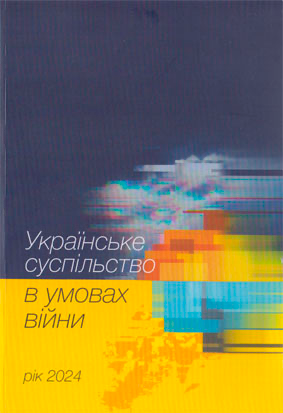
The collective monograph by researchers of the Institute of Sociology of the National Academy of Sciences of Ukraine continues an annual description of Ukrainian society in conditions of the large-scale war. A number of topics have been addressed, such as Ukrainians’ public opinion, theoretical aspects of the sociology of war, split lines and inequality modes, social resources and social institutions; furthermore, specific population groups have been studied. What distinguishes this monograph is drawing upon trustworthy empirical evidence from the “Ukrainian Society” social survey, which was collected in a considerably broader format in 2024 than in the first two years of the war. Tables with the survey data distributions are presented in appendices to the book. The proposed materials should be of interest to both social scientists and all those striving to understand more deeply Ukrainian society in conditions of a long military stand-off.